
Emergency response · Metro Atlanta
Water Damage Restoration in Atlanta
We are the plumber and the restoration crew. That means the water stops and the drying starts on the same visit, instead of days later after a second company finally gets scheduled. Insurance claims are welcome and documented as we work.
- ✓24/7 dispatch
- ✓Structural drying
- ✓Claim documentation
Licensed since
1999
- Response
- 24 / 7
- Since
- 1999
- Counties served
- 7 metro
- Call us
- (404) 380-7641
First hour matters
What to do the moment you find water
Damage cost tracks almost entirely with how long materials sit wet. These four steps protect the house before we arrive.
Shut off the main
Stop the source. On a water heater, close the cold inlet valve on top of the tank.
Kill power to wet areas
If water is near outlets, panels, or appliances, switch off those breakers before walking through it.
Move what you can
Lift furniture legs, pull rugs off hardwood, and get boxes and electronics off the floor.
Photograph everything
Wide shots and close-ups before cleanup starts. Your adjuster will ask, and it strengthens the claim.
Call (404) 380-7641
We dispatch immediately, any hour, and bring extraction and drying equipment with the repair truck.
Do not wait to dry
Fans and open windows are not structural drying. Trapped moisture in subfloor and wall cavities needs metered equipment.
Our process
How a restoration job runs
- 1
Stop the water and assess
We repair or isolate the failure first, then map how far moisture travelled using meters and thermal inspection rather than guessing from what looks wet.
- 2
Extraction
Standing water comes out with truck and portable extraction, including water pulled from carpet pad and under cabinet toe kicks.
- 3
Controlled drying
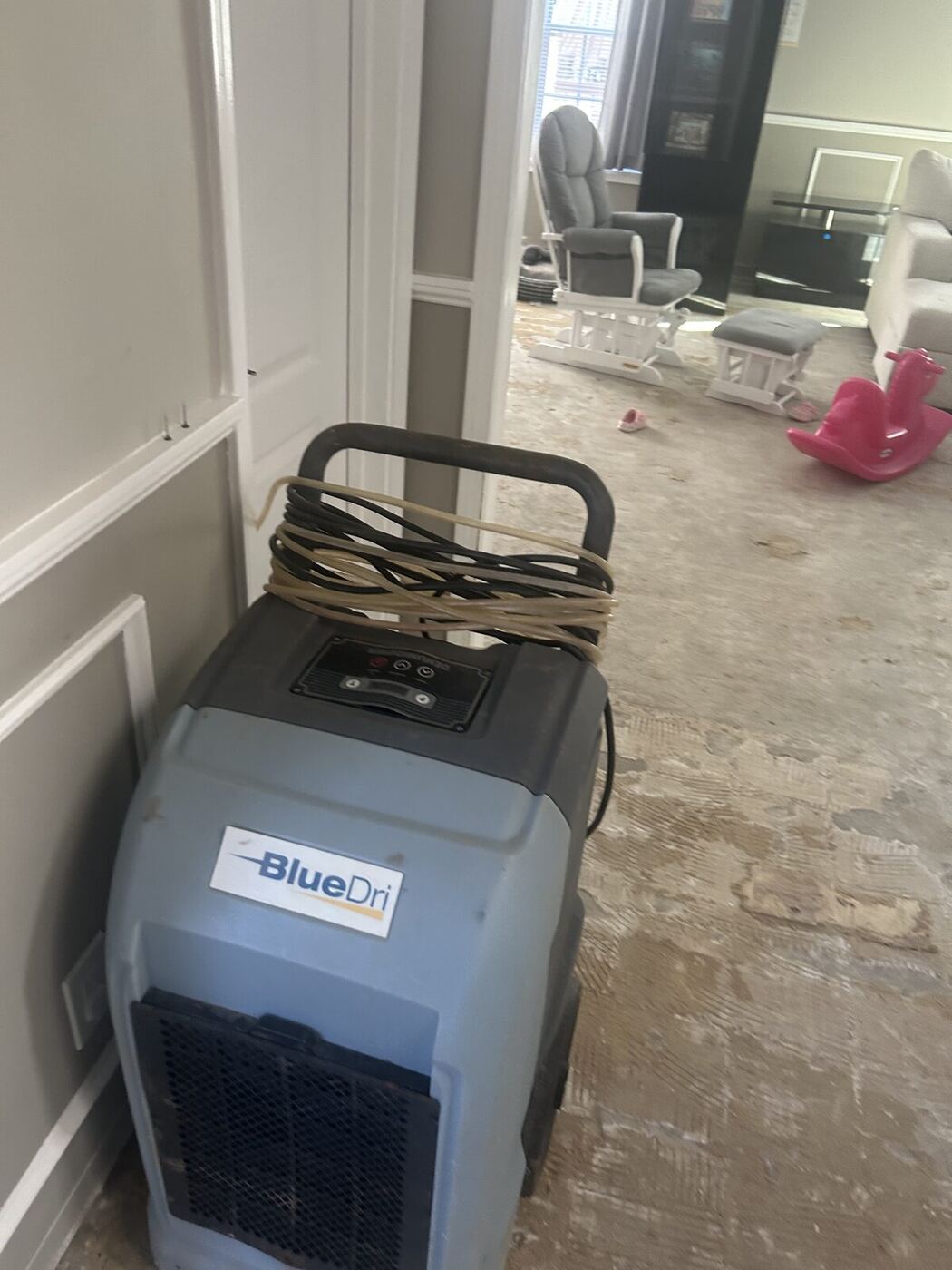
Air movers and dehumidifiers are placed to dry the specific assemblies that got wet. Readings are logged daily so equipment stays until materials are actually dry.
- 4
Remove what cannot be saved
Saturated insulation, swollen particleboard, and compromised drywall are cut out cleanly, contained, and hauled off.
- 5
Documentation and rebuild
Photos, moisture logs, and scope go to your insurer. We then handle the repairs needed to put the space back together.
Tap any photo for the full story.
Causes we see
Where Atlanta water damage usually starts
Supply line failures top the list: braided washing machine hoses, ice maker lines, angle stops under sinks, and water heater tanks that finally split. These flood fast because they are pressurized, and a small line can move hundreds of gallons before anyone notices.
Drain and sewer backups are the second category, and dirtier. A blocked main sends wastewater up through the lowest fixtures, which usually means a finished basement or a ground floor bathroom. Those jobs need sanitizing, not just drying.
Then there is weather and building envelope: hard winter freezes splitting hose bibbs and crawlspace pipe, summer storms overwhelming yard drainage and pushing groundwater against foundations, and long-running slab or wall leaks that only show up as a stain, a warm spot, or a water bill that climbed for no reason.
Insurance
Working with your insurance carrier
Most sudden, accidental water losses are covered. What gets claims reduced or denied is thin documentation and slow mitigation, since policies require the homeowner to limit further damage once the loss is known.
We photograph the source and affected areas, record daily moisture readings by room and material, keep an equipment log, and write a scope your adjuster can match to their own estimate. You are welcome to loop us in directly with the adjuster so the technical questions get answered without you in the middle.
Coverage
Water restoration by service area
Clayton, DeKalb, Gwinnett, Fulton, Cobb, Douglas, and Cherokee counties. Open your city for local details and response times.
Questions
Frequently asked questions about water damage
How fast do you respond to water damage in Atlanta?+
Emergency water calls are answered 24 hours a day and dispatched immediately. Call (404) 380-7641. Drying equipment usually goes in on the same visit that stops the leak.
Do you work with my insurance company?+
Yes. Insurance claims are welcome. We photograph damage, log moisture readings daily, and provide the documentation adjusters ask for.
How long does structural drying take?+
Most residential jobs run three to five days depending on how much water was absorbed, the materials involved, and humidity. We monitor with meters rather than guessing when to pull equipment.
Can hardwood floors and cabinets be saved?+
Often, if drying starts quickly. Hardwood and cabinetry that would be demolished after a week of sitting wet can frequently be dried in place when equipment goes in within the first day.
Do you handle mold concerns?+
Fast, verified drying is the main defense against mold. If growth already started, we remove affected material and treat the area before rebuild.
Water in the house right now?
Shut off the main and call (404) 380-7641. We dispatch 24/7 across metro Atlanta and bring drying equipment with the repair truck.